The FIFA World Cup 2026 will mark a historic first in football history as three countries jointly host the tournament. With 48 teams and 104 matches, this edition will be the largest ever, and the hosting responsibilities will be shared by the United States, Canada, and Mexico. This multi-nation approach reflects a major shift in how global sporting events are organised, combining infrastructure, resources, and fan bases across North America.
Introduction: A First-of-Its-Kind World Cup
The FIFA World Cup 2026 introduces a groundbreaking hosting model. For the first time, three nations will jointly organise the tournament, creating a continental-scale event.
The host countries, United States, Canada, and Mexico, will collectively manage logistics, stadiums, and operations across 16 host cities.
This structure aligns with the expansion to 48 teams, requiring more venues, larger capacity, and wider geographic reach. It also represents a shift toward collaboration in global sports hosting.

United States: The Primary Host and Final Venue
Largest Share of Matches
The United States will host the majority of matches.
- Expected to host 60 out of 104 matches
- Includes knockout rounds from Round of 32 onward
- Final match scheduled in New York/New Jersey
Infrastructure and Stadiums
- Hosts 11 out of 16 cities
- Stadiums with capacities exceeding 70,000
- Advanced transport and hospitality systems
Role in the Tournament
The United States serves as the central hub of the tournament, handling the most critical stages, including the final. Its infrastructure and commercial market make it the backbone of the event.
Mexico: The Cultural and Historic Host
A Record-Breaking Host Nation
The Mexico will make history as:
- The first country to host three World Cups (1970, 1986, 2026)
Key Matches
- Opening match expected in Mexico City
- Hosts around 10 matches
Role in the Tournament
Mexico brings legacy and football culture to the event. Its stadiums, especially Estadio Azteca, are iconic in World Cup history, making it the symbolic starting point of the tournament.
Canada: Expanding Football’s Reach
Growing Football Nation
The Canada will host World Cup matches for the first time in history.
- Hosts around 10 matches
- Matches in cities like Toronto and Vancouver
Infrastructure and Development
- Modern stadium facilities
- Strong urban connectivity
- Increasing investment in football
Role in the Tournament
Canada represents the expansion of football into newer markets. Its inclusion highlights FIFA’s goal of growing the sport beyond traditional strongholds.
Distribution of Host Cities
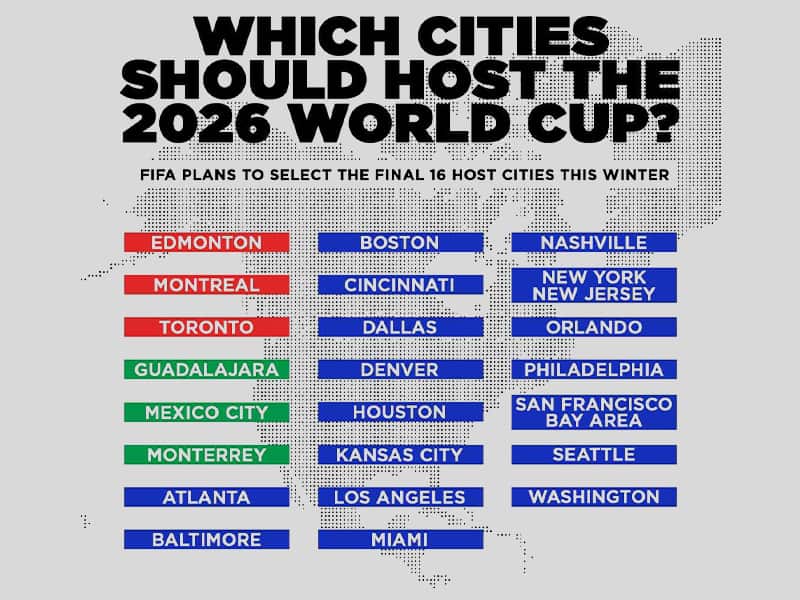
The tournament will be played across 16 cities:
- United States: 11 cities
- Canada: 2 cities
- Mexico: 3 cities
This wide distribution ensures:
- Greater fan accessibility
- Regional diversity
- Increased ticket availability
How Hosting Responsibilities are Shared
Match Allocation
- Total matches: 104
- United States: ~60 matches
- Canada and Mexico: ~10 matches each
Operational Coordination
- Joint planning between three governments
- Shared security and logistics frameworks
- Cross-border travel coordination for teams and fans
Economic Impact
- Boost in tourism across all three countries
- Infrastructure upgrades
- Increased global visibility

Why FIFA Chose Three Host Nations
-
Supporting a 48-Team Tournament
The expanded format requires:
- More stadiums
- Larger accommodation capacity
- Efficient travel systems
No single country could easily manage this scale alone.
-
Regional Collaboration
North America offers:
- Strong infrastructure
- High commercial potential
- Established sports culture
-
Expanding Global Reach
Hosting across three nations allows:
- Wider audience engagement
- Greater cultural representation
- Increased accessibility for international fans
Key Statistics at a Glance
- Host countries: 3
- Total teams: 48
- Total matches: 104
- Host cities: 16
- Tournament duration: 39 days
Frequently Asked Questions
- Which countries are hosting the 2026 World Cup?
The tournament will be hosted by the United States, Canada, and Mexico. This is the first time three countries will jointly host the FIFA World Cup.
- Why are three countries hosting the tournament?
The expansion to 48 teams requires more infrastructure and venues. Sharing hosting responsibilities allows better management of logistics, travel, and stadium capacity.
- Where will the final match be played?
The final is expected to be held in the United States, specifically in the New York/New Jersey region.
- How many matches will each country host?
The United States will host around 60 matches, while Canada and Mexico will host approximately 10 matches each.
- Has any country hosted three World Cups before?
Mexico will become the first country to host the FIFA World Cup three times, having previously hosted in 1970 and 1986.
Conclusion
The FIFA World Cup 2026 hosting model represents a historic shift in global sports organisation. With three countries sharing responsibilities, the tournament reaches an unprecedented scale. The United States leads in infrastructure and match hosting, Mexico contributes historical significance, and Canada expands the sport’s footprint. Together, they create a truly continental World Cup that reflects the growing global nature of football.